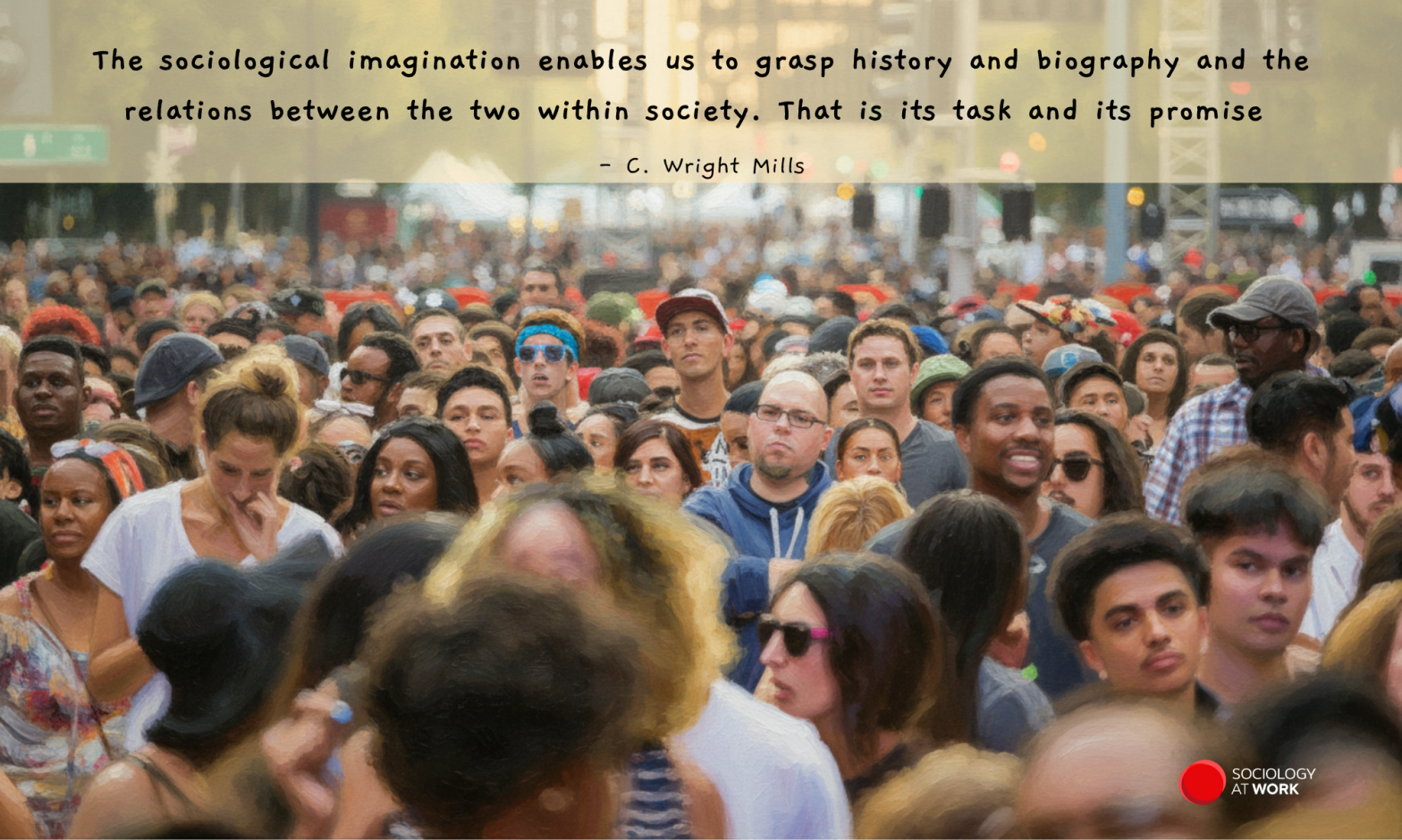
Today’s sociology quote is from C. Wright Mills’ (1959) classic, The Sociological Imagination.
“Neither the life of an individual nor the history of a society can be understood without understanding both.”
C. Wright Mills (1959: 3)

History and biography
Mills argues that people sometimes feel “trapped” by their troubles or their personal circumstances. For example, people have obligations to their families, they have commitments at work, their actions are restricted by fear of gossip in their friendship groups, or they might feel as if they have to live their lives in particular ways because society forces this upon us.
At the same time, most people understand their lives as being unique. Falling in love, the type of jobs we end up pursuing or those we miss out on, the decision to live alone or the types of families we form – these are all choices that are mediated (or shaped) by the the time and place we live. People rarely think about their life choices – nor the lives of others – as the outcome of institutions and history.
Societies have a tendency to view certain life trajectories negatively: being homeless, being unemployed, teen pregnancies, addiction, incarceration – people often blame the individual for pathways that “deviate” from the norm.
Some people might think about a handful of external influences as having direct impact on their lives – religion, family or perhaps the media – but they do not always see the complex interplay between various social forces.
Sociology makes this connection between the individual (biography) and broader social structures. This is why Mills says that in order to understand an individual we must understand history and vice versa.
“The sociological imagination enables us to grasp history and biography and the relations between the two within society. That is its task and its promise.”
C. Wright Mills (1959: 6)
Applied sociology
In The Sociological Imagination, C. Wright Mills saw many applications of sociology beyond the academy. He discussed how sociology can be used to carry out “microscopic studies” to challenge the economic assumptions that drive social policies (1959: 127). That is, to not only focus on widescale economic drivers of behaviour, but to gather empirical evidence that challenges taken-for-granted assumptions of social issues.
Chapters 4 and 5 engage with a critique of sociological research that is watered down by bureaucracy, particularly to “predict” trends and to manage human relations. Mills sees this happens to sociologists both inside and outside academia as they ascend the corporate ladder.
“Their positions change—from the academic to the bureaucratic; their publics change—from movements of reformers to circles of decision-makers; and their problems change—from those of their own choice to those of their new clients. The scholars themselves tend to become less intellectually insurgent and more administratively practical. Generally accepting the status quo, they tend to formulate problems out of the troubles and issues that administrators believe they face.”
C. Wright Mills (1959: 96)
Later, Mills writes:
“Research for bureaucratic ends serves to make authority more effective and more efficient by providing information of use to authoritative planners.”
C. Wright Mills (1959: 117)
He argues a way to avoid this is to focus on “structural transformation” as the end goal of the sociological imagination, rather than simply producing research for the sake of publication or knowledge creation (1959: 68). He writes:
“By our choice and statement of problems, we must first translate indifference into issues, uneasiness into trouble, and second, we must admit both troubles and issues in the statement of our problem. In both stages, we must try to state in as simple and precise a manner as we can, the several values and threats involved, and try to relate them.
“Any adequate ‘answer’ to a problem, in turn, will contain a view of the strategic points of intervention—of the ‘levers’ by which the structure may be maintained or changed; and an assessment of those who are in a position to intervene but are not doing so”
C. Wright Mills (1959: 131)
In the concluding chapter, Mills returns to these themes, with a summary of how to best use the sociological imagination for positive social change (1959: 224-226):
- Be a good craftsperson: Use theory and methods in your practice, rather than simply “fetishising” specific techniques. (In an earlier chapter, he gives the example of producing data for evaluations in policy work, devoid of critical analysis.) “Above all, seek to develop and to use the sociological imagination.” (1959: 224)
- Communicate clearly: Avoid jargon. Don’t hide behind big words to avoid making critical judgements and tough recommendations.
- Ground your work in historical specificity (“transhistorical constructions”): Connect “little facts and their relations” to “big unique events.” Solve problems, but avoid being too abstract. A good rule of thumb: “never write more than three pages without at least having in mind a solid example” (1959: 224).
- Study the interplay of social context and social structures: Don’t simply describe social problems as a journalist would, with specific facts and figures. Instead, zoom out, and place issues within the broader social and historical context over time and place.
- Maintain a comparative perspective: Make connections between the current issue and other the societies and social structures.
- Beware of your biases: Understand how your own ideas and experiences shape your sociological imagination. Continually revise how you connect problems of biography, social structure, and history.
- Shed light on our current reality: People are not merely individuals, instead, they are shaped by history, culture, and social context. “Before you are through with any piece of work, no matter how indirectly on occasion, orient it to the central and continuing task of understanding the structure and the drift, the shaping and the meanings, of your own period, the terrible and magnificent world of human society in the second half of the twentieth century” (1959: 225).
- Maintain your “moral and political autonomy”: Don’t accept official definitions of public issues. Don’t allow bureaucracy to shape your work. Always demonstrate how individual problems and patterns are interconnected with biography and history.
Finally, remember the goal of the sociological imagination is not merely to observe, document, record, or analyse problems. Rather, the sociological imagination is exercised by creating change. This is where applied sociology has its greatest impact. Our role is to create positive social transformation through direct interventions.
“Know that the problems of social science, when adequately formulated, must include both troubles and issues, both biography and history, and the range of their intricate relations. Within that range the life of the individual and the making of societies occur; and within that range the sociological imagination has its chance to make a difference in the quality of human life in our time.”
C. Wright Mills (1959: 226)
Notes
Post last updated on 22 March 2026, with additional quotes and images.
Discover more from Sociology at Work
Subscribe to get the latest posts sent to your email.
 Sociology at Work